Building where she did not rule
The striking fact about Ahilyabai Holkar’s temple patronage is geographical. The Holkar state occupied part of central India. Her building reached the Himalayan passes, the Gujarat coast, the Odisha shore and the Tamil country.
This was a recognised way for an Indian ruler to act at a scale larger than their territory. Patronage at the great pilgrimage sites put a ruler’s name in front of people from every region of the subcontinent, established standing among religious institutions with their own networks and influence, and did so without a single soldier crossing a border.
It was also, in the conditions of the later eighteenth century, genuinely needed. Many of these sites had suffered damage, neglect or the collapse of their endowments during the preceding century of political disruption. A patron with money, administrative competence and no local political ambitions was useful to them.
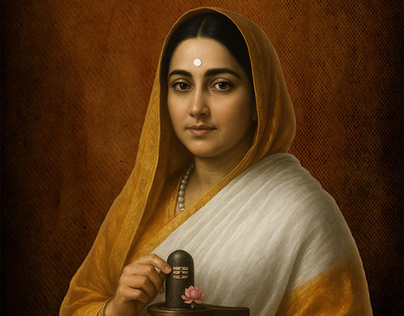
An index of associated sites
Expand a region to see the places most consistently associated with her patronage. Where a site’s attribution rests on local tradition rather than firm documentation, that is indicated.
- Kashi Vishwanath, Varanasi
- The temple was rebuilt under her patronage in 1780, on a site whose earlier structure had been destroyed in the seventeenth century. It is the single most widely known work associated with her name, and it remains one of the most visited temples in India.
- Ahilya Ghat, Varanasi
- A ghat on the Ganges carrying her name, part of a broader programme of riverfront construction and repair in the city.
- Vishnupad Temple, Gaya
- The present temple is attributed to her patronage in the 1780s. Gaya is a principal site for ancestral rites, and the temple receives very large numbers of pilgrims.
- Ayodhya, Mathura, Haridwar
- Temples, ghats and rest-houses at major pilgrimage centres of the northern plain, generally recorded as endowments and repairs rather than wholly new foundations.
- Maheshwar
- Her capital, and the most concentrated body of her work: temples along the riverbank, the ghats, and the fort and palace complex above them.
- Omkareshwar
- A major Shiva site on an island in the Narmada, upstream of Maheshwar, associated with her patronage and endowment.
- Ujjain
- One of the principal sacred cities of central India, on the Shipra. Repairs, ghats and endowments are attributed to her here.
- Indore
- The Holkar administrative centre before her move to Maheshwar, and the city that carries her name most visibly today.
- Somnath, Gujarat
- She is credited with building a temple at Somnath in the later eighteenth century, at a site with a long history of destruction and rebuilding. The present principal temple there is a twentieth-century construction; the temple attributed to her stands separately.
- Dwarka
- Endowments and works at one of the four principal pilgrimage destinations of the Hindu tradition.
- Nashik and Trimbakeshwar
- Works on the Godavari and at the Shiva site at Trimbak, both major centres of pilgrimage in the northern Deccan.
- Badrinath
- Rest-houses and works supporting one of the most demanding pilgrimage routes in the subcontinent, at high altitude and open only part of the year.
- Kedarnath
- Shelter and support structures on the Kedarnath route, again in extreme conditions.
- Gangotri
- Works associated with the source region of the Ganges.
- Jagannath Puri, Odisha
- Endowments and a rest-house at one of the four principal pilgrimage destinations.
- Rameswaram, Tamil Nadu
- Works at the southern extremity of the classical pilgrimage circuit.
- Srisailam, Andhra Pradesh
- Patronage at a major Shiva site in the eastern Deccan.
- Kanchipuram, Tamil Nadu
- Endowments at one of the great temple cities of the south.

An original illustration of a north Indian temple form. Artistic impression, not a specific building.
Kashi Vishwanath, 1780
The rebuilding of the Kashi Vishwanath temple at Varanasi is the work most firmly attached to her name, and the one most often cited as the summary of her patronage.
The temple that had stood on the site was destroyed in 1669 during the reign of Aurangzeb. For over a century the principal Shiva shrine of the most important pilgrimage city in northern India stood unrebuilt. Ahilyabai financed its reconstruction on an adjacent site in 1780.
The significance of the act at the time was considerable, and it has been read politically ever since — by contemporaries, by nineteenth-century writers, and in modern commemoration. What is not in dispute is the building itself, its date, or who paid for it.
On temple patronageA note on sources. No verified and complete list of works funded by Ahilyabai Holkar exists. Figures in circulation for the total number of temples, wells or rest-houses she built vary by an order of magnitude between sources and are not reproduced here. The regional index above gives sites for which the association is widely and repeatedly recorded.
Walk the map
The places associated with her, arranged by region, with what stands at each of them.