Learning and letters
Support for scholars and for the institutions that trained them. Patronage of learning was an expected function of an Indian ruler of the period, and hers was directed largely through the religious foundations she endowed.
It is easy to read a list of temples and endowments as piety and stop there. It is more accurate to read it as public spending — on institutions, on employment, and on the physical maintenance of a cultural inheritance.
A temple endowment of the kind Ahilyabai settled repeatedly did several things at once. It paid for the fabric of a building. It funded the priests, musicians, cooks, cleaners and administrators attached to it. It often supported a school, a kitchen and a rest-house. And because it was settled as a permanent charge on land or revenue, it went on doing all of this indefinitely.
Multiply that across dozens of sites in every direction from Malwa and the scale of the cultural investment becomes clearer than any list of buildings suggests.
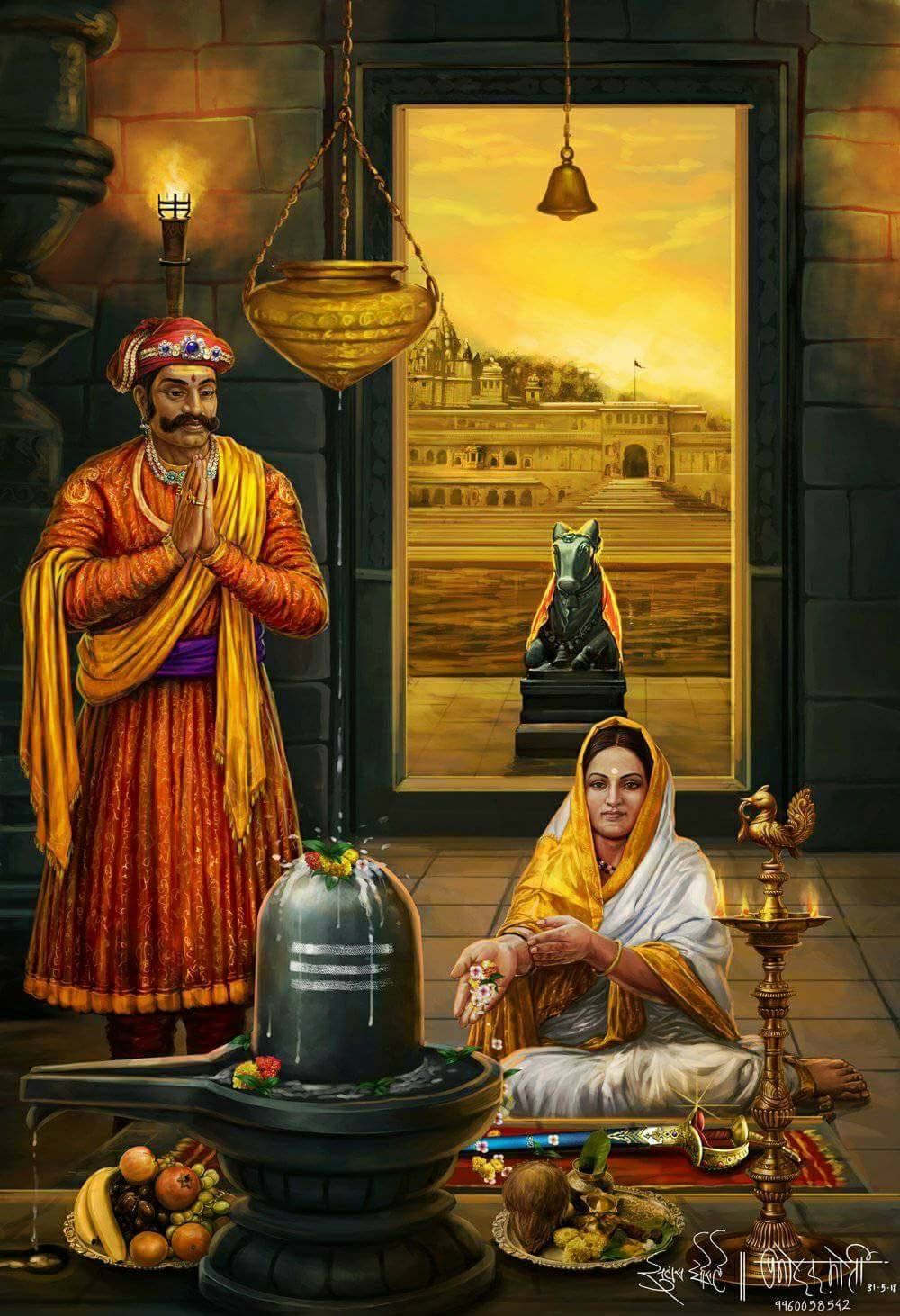
A devotional painting in the popular tradition, showing worship at a Shiva shrine with a temple and ghat visible beyond.
Support for scholars and for the institutions that trained them. Patronage of learning was an expected function of an Indian ruler of the period, and hers was directed largely through the religious foundations she endowed.
Endowments that funded not only buildings but the observances carried on inside them — the daily services, the annual festivals, and the people employed to maintain both.
The settlement of weavers at Maheshwar and the encouragement of a textile industry that became the town’s defining trade and has continued to the present day.
The temple and court establishments she funded carried musicians and performers as a matter of course. This is the least separately documented area of her patronage and the most easily overstated.
By building and repairing at sites across the subcontinent, her patronage helped keep a network of pilgrimage places physically usable — a cultural contribution as much as a religious one.
The endowment model she used tied maintenance funding to the works themselves, which is a principal reason that so much of what she paid for is still functioning.
Of all her cultural interventions, the establishment of weaving at Maheshwar is the one with the most continuous life. Ahilyabai is credited with bringing weavers to the town and with supporting the production of fine cotton and silk cloth there — initially, by most accounts, for use as gifts and for the court, and subsequently as a trade in its own right.
The cloth is characterised by its borders: woven, often in contrasting colour with metallic thread, and carrying geometric motifs. The reversible border is a technical signature of the tradition.
What makes this more than an anecdote about textiles is what happened afterwards. The Holkar state is gone. The fort is a monument. The weaving is a working industry, organised through cooperatives and workshops, and it remains one of the principal employers in the town.
A ruler’s cultural legacy is usually measured in what survives as heritage. This one survives as an occupation, which is a considerably harder thing to achieve.
Ahilyabai occupies an unusual place in Indian memory. She is honoured as a ruler, but the honorifics attached to her name — Lokmata, mother of the people, and Punyashlok — belong to a religious and moral register rather than a political one.
That reflects something real about how her reputation was formed. It was not built by court chroniclers celebrating victories. It was built by the very large number of people who used what she paid for, in places spread across the subcontinent, over a period of decades — and it was carried by them.
Her memory has been sustained in folk song, in regional literature and, since the nineteenth century, in printed biography and popular devotional imagery of the kind reproduced on this site. Modern commemoration is extensive: the university and airport at Indore both carry her name, and her birth anniversary is publicly observed.
A note on sources. Popular devotional imagery and folk narrative are valuable evidence of how Ahilyabai Holkar has been remembered, but they are not evidence of specific historical events. This site treats them as the former.
Temples, ghats and rest-houses across India, and the town she made her capital.