Born at Chondi
Born in the village of Chondi, in the Jamkhed area of present-day Ahmednagar district, Maharashtra. Her father, Mankoji Shinde, was the village patil — the headman responsible for revenue and local dispute settlement.
Dates follow the most widely accepted accounts. Where sources disagree, or where a date is approximate, that is stated on the entry itself.
Born in the village of Chondi, in the Jamkhed area of present-day Ahmednagar district, Maharashtra. Her father, Mankoji Shinde, was the village patil — the headman responsible for revenue and local dispute settlement.
Married, as a child and in the ordinary manner of the period, to Khanderao Holkar, son of Malhar Rao Holkar. The marriage took her from a Deccan village into one of the principal military households of the Maratha expansion.
Malhar Rao Holkar established and extended Holkar control over territory in Malwa under the broad authority of the Peshwa at Pune. The state Ahilyabai would later govern took shape during these years.
Her son Male Rao and her daughter Muktabai were born during this period. Precise birth dates are given differently across sources and are not asserted here.
Khanderao Holkar was killed during the siege of Kumher, in Bharatpur. Ahilyabai was then about twenty-nine. Accounts handed down describe her intending to perform sati and being dissuaded by Malhar Rao Holkar; this belongs to the tradition surrounding her rather than to contemporary documentation.
She remained within the Holkar establishment and worked alongside her father-in-law. By the end of this period she had a practical command of the state’s revenue, correspondence and civil affairs.
The third battle of Panipat was a severe defeat for the Maratha confederacy and reshaped the political conditions in which every constituent house, including the Holkars, subsequently operated.
The founder of Holkar authority in Malwa died. His grandson, Ahilyabai’s son Male Rao, succeeded him.
Male Rao died within about a year of his succession. In roughly twelve months the state had lost both the man who built it and the heir intended to continue it.
Rather than allow the government to pass elsewhere, she sought and obtained recognition of her authority over the Holkar territories, retaining civil administration in her own hands.
She established her seat at Maheshwar, on the north bank of the Narmada — a deliberate move away from the military centre at Indore, to a river town of long-standing religious significance.
Military command was exercised by Tukoji Rao Holkar throughout her rule, while revenue, justice, public works and external correspondence ran through her. The arrangement held for twenty-eight years.
Wells, step-wells, tanks, roads, river crossings, rest-houses and kitchens, built along pilgrimage and trade routes and endowed for their upkeep — the most sustained element of her rule.
The principal Shiva temple of Varanasi, destroyed in 1669 and unrebuilt for over a century, was reconstructed under her patronage. It is the single best-documented work associated with her name.
The present Vishnupad temple at Gaya is attributed to her patronage in this decade, as is a temple at Somnath on the Gujarat coast.
Weavers were settled in the town and a cotton-and-silk textile industry established. It became Maheshwar’s defining trade and has continued without interruption to the present day.
Ahilyabai Holkar died at her capital, having governed the Holkar state for roughly twenty-eight years. Tukoji Rao Holkar succeeded her.
Tukoji Rao Holkar, her military commander throughout the reign, took over the state. He died in 1797.
The Scottish poet Joanna Baillie published Ahalya Baee, a long poem on her life — an unusual mark of how far her reputation had travelled by the nineteenth century.
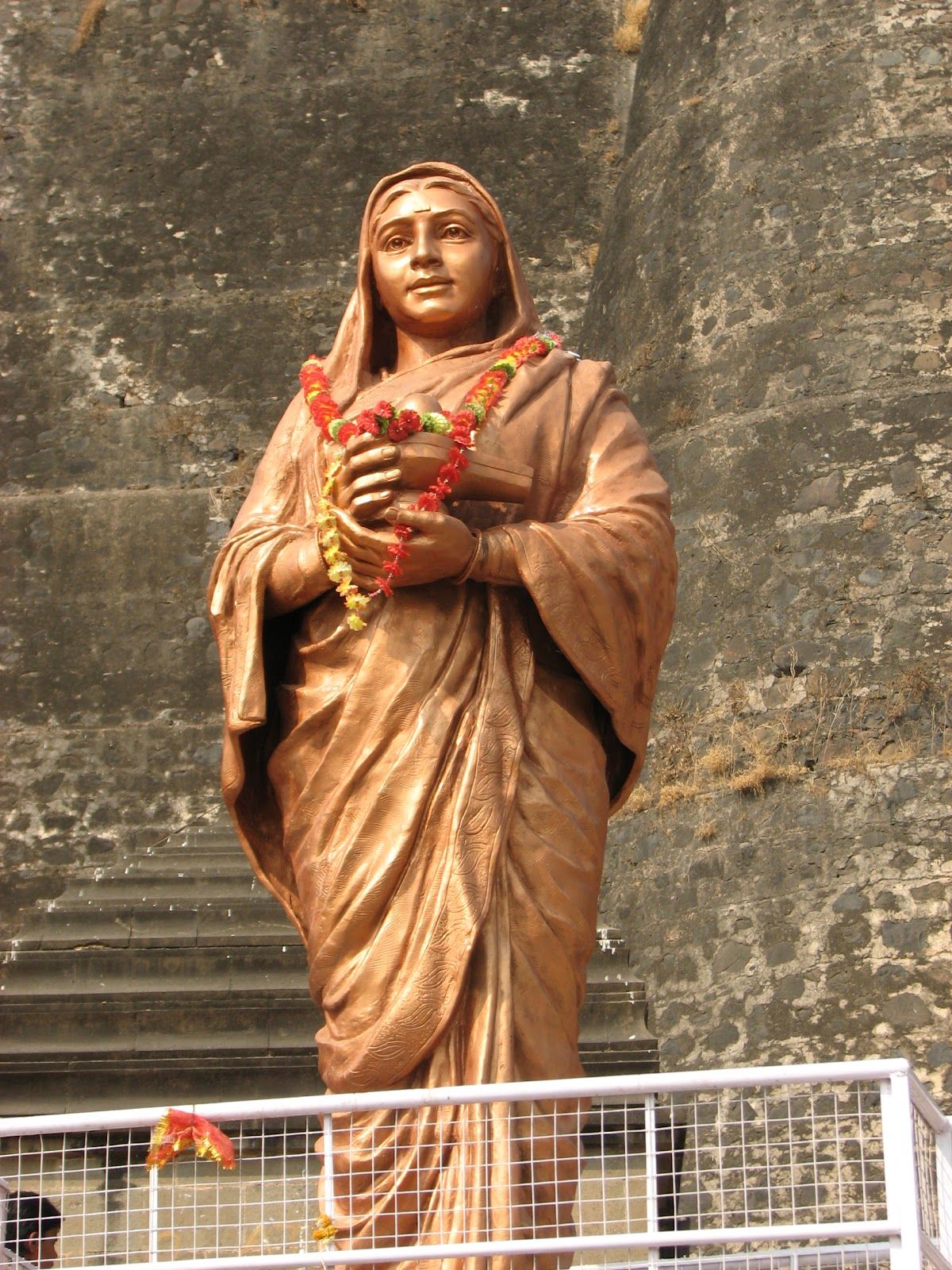
The university and the airport at Indore both carry her name, statues stand in towns across Maharashtra and Madhya Pradesh, India Post has issued a commemorative stamp, and her birth anniversary is publicly observed each year.
The tricentenary of her birth in 1725 was marked by commemorative programmes across India.
A note on sources. Eighteenth-century Indian dating is recorded in several calendars, and conversions between them are not always consistent across sources. The dates above reflect the values most commonly given in modern accounts; a small number of them are approximate, and are marked as such.
The towns, temples and riverfronts connected with her life and her patronage.