Why here
When Ahilyabai took up the government of the Holkar territories, the administrative centre was at Indore. She moved her seat to Maheshwar, roughly ninety kilometres to the south-west, on the Narmada. The move was deliberate, and it tells you a good deal about how she intended to govern.
Maheshwar is an ancient site, identified with the Mahishmati of Sanskrit literature, and it sits on a river regarded as sacred along its entire length. It is a place of religious weight. It was also, in practical terms, a river town with a fort, at a distance from the military establishment at Indore.
The choice separated her civil government physically from the army — consistent with the division of authority she had established — and placed it somewhere that pilgrims and traders already came.

An original illustration in the manner of the Maheshwar riverfront. It is an artistic impression of the arrangement of fort, temples and ghats, not a survey of the actual buildings.
The fort and the palace
The fort stands on the bank above the river, and within it is the residence associated with Ahilyabai — a modest building by the standards of eighteenth-century Indian palaces, and consistently described as such by visitors then and since.
Its scale is part of the point. She is uniformly reported as having lived plainly and as having kept a clear boundary between the revenues of the state and her own resources. The building supports the description rather than contradicting it.
The complex also housed the working apparatus of government: the durbar at which she heard petitions, the offices that handled revenue and correspondence, and the workshops attached to the establishment.
The ghats and the temples
Below the fort the bank is worked into a long sweep of stone steps running down to the Narmada, punctuated by temples and by small domed pavilions.
This is the element of Maheshwar that most people picture, and it is the fullest surviving expression of the arrangement she repeated across India: shrine, steps, water, shelter. Here the whole composition was built as one thing, on a single stretch of bank, over a sustained period.
It remains in daily use. The ghats are not a monument in the sense of something visited and left; they are the town’s working relationship with its river.
A capital that made things
Ahilyabai brought weavers to Maheshwar. That decision — taken, by most accounts, to supply cloth for the court and for gifts — turned into the town’s defining industry.
Maheshwari cloth is woven in cotton and silk, and is identified above all by its borders: geometric, often in metallic thread, and characteristically reversible. The technique has been passed down within weaving families for generations.
It is still worked in the town today, on pit looms, and it remains a significant source of employment. Of everything Ahilyabai established at Maheshwar, the weaving is the part that has never stopped.

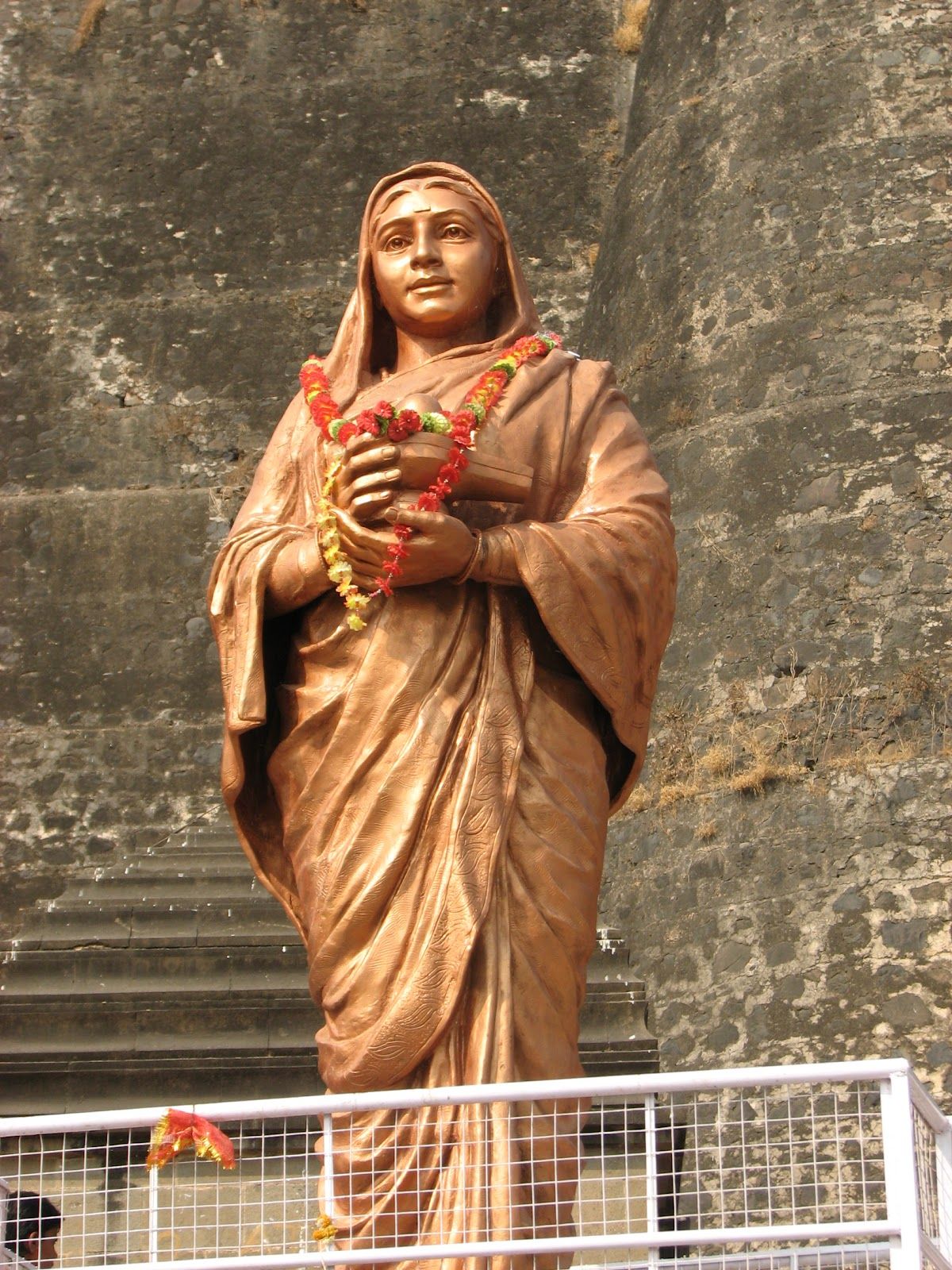
Commemorative sculpture at a fort site. Statues of Ahilyabai Holkar stand in many towns across Maharashtra and Madhya Pradesh.
Maheshwar today
Ahilyabai died at Maheshwar on 13 August 1795. The Holkar capital moved back to Indore in the following century, and the town returned to something closer to its earlier scale.
What it retained was the physical fabric of her rule — the fort, the ghats, the temples along the bank — and the industry she had planted. Both are still there. The fort complex is partly a heritage property; the riverfront is in continuous religious and domestic use; the looms are working.
It is an unusually complete survival. Most eighteenth-century Indian capitals are known through ruins or through later cities built over them. Maheshwar is legible as the place she made it.
A note on sources. Maheshwar’s identification with the Mahishmati of the Sanskrit epics is traditional and long-established, but not archaeologically settled. The account of the town given here concentrates on the eighteenth-century period, for which the evidence is substantially better.
Continue exploring
Her chronology, the places connected with her, and the stories that have gathered around her name.