Maheshwar, Madhya Pradesh
Her capital, on the north bank of the Narmada. The fullest surviving expression of everything her rule was about.
The fort and the residence associated with her stand above the river. Below them the bank is worked into a long sweep of stone ghats, punctuated by temples and small domed pavilions. The whole riverfront was built as one composition over the course of her reign.
Maheshwar is also where the handloom weaving she established is still worked. Of the places on this page it is the one where the eighteenth century is least separable from the present day.
The Maheshwar legacy in full
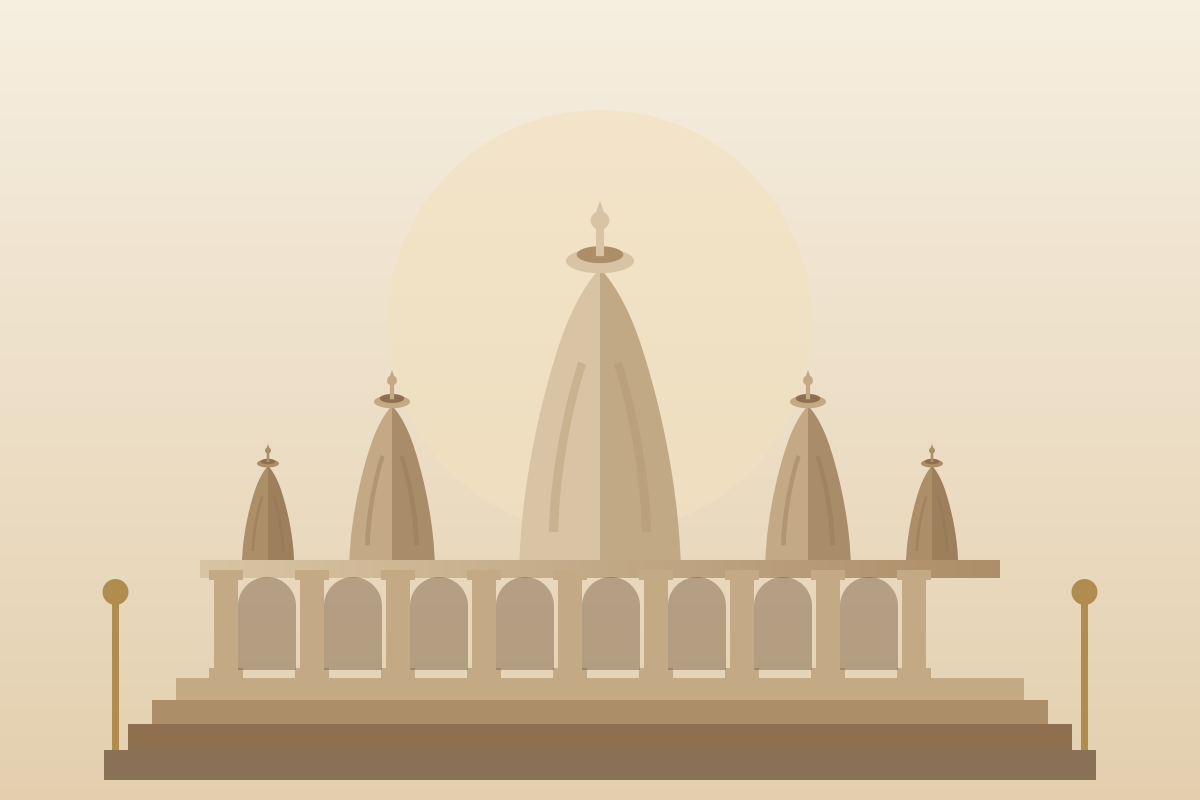
An original illustration in the manner of the Maheshwar riverfront — an artistic impression of the arrangement, not a survey of the buildings.
Varanasi, Uttar Pradesh
The Kashi Vishwanath temple, rebuilt under her patronage in 1780, and the ghat on the Ganges below it that carries her name.
The temple that stood on the site was destroyed in 1669. For more than a century the principal Shiva shrine of the most important pilgrimage city in northern India was not rebuilt. Ahilyabai financed its reconstruction on an adjacent site.
Ahilya Ghat, on the riverfront below, belongs to the same programme — part of a wider body of construction and repair she funded along the Ganges at Varanasi. Both remain in intensive daily use.
The full temple indexChondi, Maharashtra
A village in the Jamkhed area of Ahmednagar district, and the place she was born on 31 May 1725.
Her father held the office of patil here — the headman responsible for the village’s revenue and its disputes. It is a small place, and the distance between it and the government of a state in Malwa is the single most remarkable fact about her life.
Chondi is today a site of commemoration, and her birth anniversary is observed there each year.
Other places associated with her
Sites where her patronage is widely and consistently recorded, listed from central India outward.
- 01 Omkareshwar, Madhya Pradesh
- A Shiva site on an island in the Narmada, upstream of Maheshwar, associated with her endowment and repair.
- 02 Ujjain, Madhya Pradesh
- One of the principal sacred cities of central India, on the Shipra. Ghats, repairs and endowments are attributed to her.
- 03 Indore, Madhya Pradesh
- The Holkar administrative centre. The city carries her name today through its university and its airport.
- 04 Gaya, Bihar
- The present Vishnupad temple is attributed to her patronage in the 1780s.
- 05 Somnath, Gujarat
- A temple built at her expense in the later eighteenth century, standing separately from the twentieth-century principal temple.
- 06 Dwarka, Gujarat
- Endowments and works at one of the four principal pilgrimage destinations.
- 07 Nashik & Trimbakeshwar, Maharashtra
- Works on the Godavari and at the Shiva site at Trimbak.
- 08 Badrinath & Kedarnath, Uttarakhand
- Rest-houses and support structures on two of the most demanding pilgrimage routes in the subcontinent.
- 09 Gangotri, Uttarakhand
- Works associated with the source region of the Ganges.
- 10 Jagannath Puri, Odisha
- A rest-house and endowments at one of the four principal pilgrimage destinations.
- 11 Rameswaram, Tamil Nadu
- Works at the southern extremity of the classical pilgrimage circuit.
- 12 Srisailam, Andhra Pradesh
- Patronage at a major Shiva site in the eastern Deccan.
- 13 Kanchipuram, Tamil Nadu
- Endowments at one of the great temple cities of the south.
- 14 Chondi, Maharashtra
- Her birthplace, in the Jamkhed area of Ahmednagar district; a memorial site today.
A note on sources. This is not a complete inventory, and no verified complete inventory exists. Some attributions are firmly documented; others rest on local tradition and later record. Visitors planning a trip should check current access, opening arrangements and conservation status locally, as these change.
Reading the map
Laid out together, the pattern of these places says something that no individual site does. They follow the pilgrimage routes of the subcontinent almost exactly — the Himalayan shrines, the Gangetic cities, the four dhams at the cardinal points, the Narmada and the Godavari.
That is not the footprint of a state. It is the footprint of a road network, and of the people who used it. Her building programme was organised around where ordinary travellers actually went, and it is the clearest single piece of evidence for what she thought government was for.
The stories attached to these places
What has been told about her, what is documented, and how to tell the two apart.